Is Niagara Falls man made or natural?
The rock and the drop are the work of an ice age. The amount of water coming over the edge tonight was decided by a committee.
Niagara Falls is natural, not man made. It was cut by the Niagara River after the last ice age, about 12,000 years ago, and the gorge below it is the record of the falls wearing backwards through the Niagara Escarpment. Nothing about the waterfall itself was built.
The water going over it is another matter. How much arrives at the edge is set by a 1950 treaty, the crest has been reshaped by engineers, and the erosion that made the gorge is now deliberately slowed.
Key takeaways
- The falls are natural. Meltwater from the last ice age cut through the Niagara Escarpment about 12,000 years ago, and the falls have been wearing upstream ever since. The gorge is the trench they left behind.
- The flow is a policy decision. A 1950 treaty between Canada and the United States sets the minimum that must go over the falls; everything above it can be diverted to hydroelectric stations, and a great deal of it is.
- The crest has been engineered. Remedial work in the mid twentieth century reshaped the lip of Horseshoe Falls so the flow spread evenly across it, and control structures upstream regulate what reaches it.
- The American Falls has been switched off. In 1969 the US Army Corps of Engineers dammed it dry for months to study the rock at its base.
- The erosion is being slowed on purpose. Diverting water is not only about electricity, it is also what keeps the falls from retreating as fast as they used to.
- What you see in January is not what you see in July. Outside the tourist season the treaty minimum halves, all day.
How was Niagara Falls formed?
Niagara Falls was made by ice, and then by the water the ice left behind. About 12,000 years ago the sheet covering this part of North America pulled back far enough to open a drainage path, and the meltwater filling what are now the Great Lakes found its way north over the Niagara Escarpment.
The rock did the rest. The escarpment is capped with a hard limestone laid down in a shallow tropical sea some 400 million years ago, and under that cap sits softer shale. Water going over the lip scours the shale out from underneath, the limestone above is left unsupported, and eventually a slab of it drops into the pool below. Then the process starts again a few metres further upstream.
That is what the gorge is: not a valley the river found, but a trench the falls dug on their way backwards. They started near where Queenston and Lewiston sit today and have worked roughly 11 kilometres upstream since. Every metre of that gorge was once the edge of the waterfall.
What is natural about Niagara Falls, and what is not?
What is natural about Niagara Falls is the rock, the drop and the gorge. What is not natural is almost everything about how the waterfall is run. Set it out row by row and the split is clean: the geology is untouched, and the operation of it is a series of decisions somebody makes.
| Natural | Managed by people | |
|---|---|---|
| The rock | Limestone over softer shale, laid down in a shallow sea about 400 million years ago | Nothing |
| The drop | Cut by meltwater after the last ice age, roughly 12,000 years ago | Nothing |
| The gorge | The trench left as the falls wore backwards from the escarpment near Queenston and Lewiston | Nothing |
| How much water goes over | The Niagara River drains four of the Great Lakes, so the supply is unusually steady | A 1950 treaty sets the minimum. The rest can be diverted to generating stations, and is |
| The shape of the crest | A curve worn by the water itself | Reshaped by remedial works in the mid twentieth century so the flow spread evenly across the lip |
| How fast it wears back | Fast enough to have moved 11 km in 12,000 years | Slowed deliberately. Less water over the edge means less cutting |
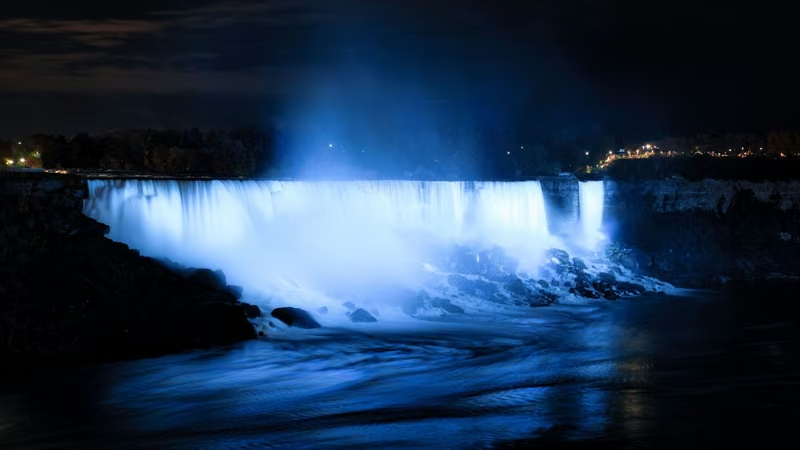
| Whether it is lit at night | Nothing | Floodlit every night of the year from the Canadian bank |
Who decides how much water goes over the falls?
How much water goes over the falls is decided by a treaty, and has been since 1950. The Niagara River is an international boundary and a very large amount of potential electricity, and the two governments settled how to share it in a treaty that is still in force.
It works by minimums. During daylight hours in the tourist season, at least 100,000 cubic feet of water per second must go over the falls. At night and outside the season the floor drops to 50,000. Everything above the minimum can be taken out of the river above the falls, run through tunnels to generating stations downstream, and put back in below.
Read that the other way round and it is startling: for much of the year, roughly half the water that would naturally go over Niagara Falls does not. The falls you photograph in July at two in the afternoon are running at a level the treaty guarantees, not a level the river chose.
What has actually been built or reshaped?
What has been built or reshaped is the crest itself, and the river above it. Taking that much water out of a river changes how the rest of it behaves, and by the middle of the twentieth century the flow over Horseshoe Falls had concentrated into the centre of the curve, cutting a notch there and leaving the flanks comparatively dry.
The remedial answer was engineering. Rock was excavated from the crest, control structures were built upstream in the river to steer the flow, and the lip was reprofiled so the sheet spread evenly across the whole horseshoe again. The result is a waterfall that looks more like a postcard of a waterfall than it did before anyone intervened.
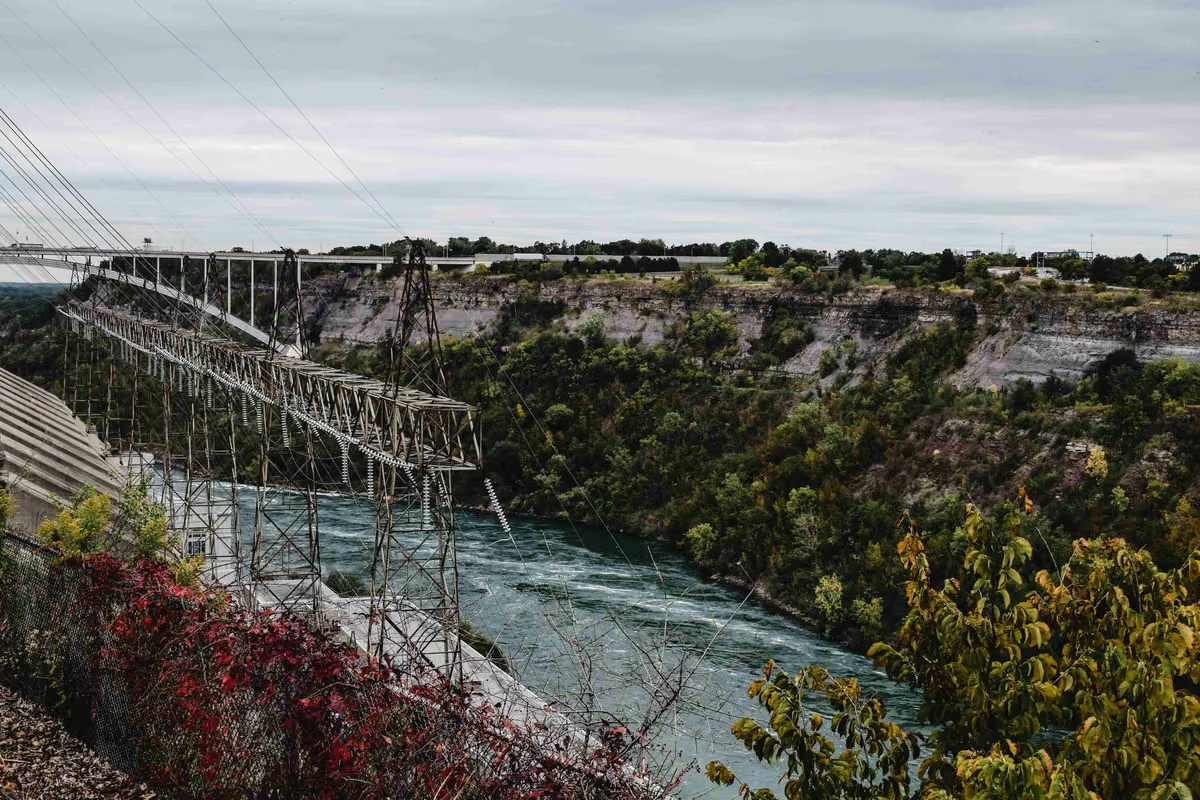
Further downstream the intervention is not subtle at all. The generating stations on both banks are among the largest structures on the river, and the tunnels feeding them run underneath the towns.

Has Niagara Falls ever been turned off?
Yes. Half of Niagara Falls has been turned off. In 1969 the American Falls was switched off, and not slowed: stopped. The US Army Corps of Engineers built a cofferdam across the channel between the mainland and Goat Island, the water was sent over the Horseshoe instead, and the American Falls ran dry for months.
The reason was the boulder pile at its base. Rockfalls had left so much talus stacked against the cliff that the falls were landing on rubble partway down rather than dropping clear, and the question was whether to haul it out. With the channel dry, engineers could walk up to the face, drill it, bolt the loose sections and survey the whole thing.
They left the talus where it was, on the grounds that removing it would cost enormously and the falls would only make more. But the photographs from that summer are the strangest images in the whole Niagara archive: a dry cliff, a puddled riverbed, and people standing on it.
They stopped the American Falls for a summer, walked up to the dry cliff, and decided to leave the rubble where it was.
Is Niagara Falls still moving?
Yes, and slower than it used to. The undercutting that built the gorge has not stopped, and the falls are still working their way upstream toward Lake Erie.
How fast is where the published figures fall apart. Rates quoted for Niagara vary by an order of magnitude depending on which century is being measured, whether the number describes Horseshoe Falls or the whole system, and whether it predates the diversions. Treat any single confident number you read, here or anywhere, as one estimate among several.
What is not disputed is the direction of travel. Sending half the river through turbines takes energy out of the water that would otherwise be spent cutting rock, so the diversions slow the retreat. The engineering that manages the falls for electricity also happens to preserve them, which is a tidier outcome than anyone was aiming for.
What does any of this change about visiting?
What all of this changes about visiting comes down to two things, and both are worth knowing before you book.
The first is timing. If you want the falls at full strength, come between late spring and early autumn and stand there in the afternoon, because that is when the treaty minimum is highest. We have set the whole calendar out in the best time to visit Niagara Falls, month by month. A January visit is a genuinely different waterfall: quieter, iced along the edges, and running at half the summer daytime flow all day.
The second is that the machinery is a sight in its own right. The water that leaves the river above the falls goes somewhere, and on the Canadian side you can follow it: the Niagara Parks Power Station is open to walk through, and a tunnel runs from beneath its generator floor out to the gorge wall.
Frequently asked questions
Is Niagara Falls man made or natural?
Niagara Falls is natural. It was cut by the Niagara River after the last ice age, roughly 12,000 years ago, when meltwater draining the Great Lakes basin began wearing through the Niagara Escarpment. Nothing about the waterfall itself was built. How much water goes over it, and the shape of the crest it goes over, are managed.
How was Niagara Falls formed?
Niagara Falls was formed at the end of the last ice age, when the retreating ice sheet opened a drainage path and meltwater from the Great Lakes basin poured over the Niagara Escarpment. The river cut through a hard limestone cap into softer shale beneath, undercutting the cap until it collapsed, and it has been repeating that ever since.
Is the water at Niagara Falls turned off at night?
No. The water at Niagara Falls is not turned off at night, but it is turned down. Under the 1950 Niagara treaty a minimum of 100,000 cubic feet per second must go over the falls during daylight hours in the tourist season, and 50,000 at other times. Everything above the minimum can be diverted to the hydroelectric stations downstream.
Has Niagara Falls ever been turned off completely?
Yes, half of Niagara Falls has been turned off completely. In 1969 the US Army Corps of Engineers built a cofferdam across the channel feeding the American Falls and left it dry for months, so engineers could study the rock and the boulder pile at its base. Horseshoe Falls, which carries most of the water, ran throughout.
Is Niagara Falls moving?
Yes, Niagara Falls is moving, upstream. The falls erode backwards as the soft shale under the limestone cap is undercut and the cap collapses, which is how the gorge below was made. Published rates vary widely depending on the period measured; what is not disputed is that diverting water for power has slowed the process considerably.
Why is Niagara Falls lit up at night?
Niagara Falls is lit up at night because the falls are run as a spectacle as well as a river. Banks of floodlights on the Canadian bank have been trained on both waterfalls for around a century. The lighting is the most visible man-made thing about the falls, and the only part of the view that is switched on and off rather than flowing.
Did people build the Horseshoe Falls crest?
No. People did not build the Horseshoe Falls crest, but they have reshaped it. The curve was worn by the river. Remedial works in the mid twentieth century removed rock and added control structures so the water spread evenly across the lip rather than concentrating in the centre, which was cutting the falls back unevenly.
Is Niagara Falls a dam?
No. Niagara Falls is not a dam. It is a natural waterfall on a natural river. There are control structures and generating stations on the Niagara River, above and below the falls, and they decide how much water reaches the edge, but the edge itself is rock the river cut.
Will Niagara Falls disappear?
No. Niagara Falls will not disappear in any timeframe that matters to a visitor. The falls are eroding upstream toward Lake Erie, and at the rates usually quoted that is a process measured in tens of thousands of years. Slowing the erosion by diverting water has pushed it further out still.
Does Niagara Falls freeze?
No. Niagara Falls does not freeze solid, though it looks close in a hard winter. The flow continues under a shell of ice and spray-formed formations on the rocks and railings. The river above the falls has jammed with ice historically, which is one reason an ice boom is installed at the Lake Erie end each winter.
Is Niagara Falls worth seeing in winter?
Yes. Niagara Falls is worth seeing in winter for the ice, but you are seeing less water. Outside the tourist season the treaty minimum halves, so the falls run at half the summer daytime flow all day. The boats do not run from December to March either.
Where these figures come from
Flow minimums, diversion and erosion at Niagara are governed by treaty and measured by the bodies that administer it. These are the places to check anything here against, and the places to pin the dates this article leaves as decades.
- International Joint Commission. The Canada and United States body that administers the 1950 Niagara treaty and publishes what it requires. www.ijc.org
- Niagara Parks. The Government of Ontario agency responsible for the Canadian shoreline, and operator of the Niagara Parks Power Station. www.niagaraparks.com
- New York State Parks. Manages Niagara Falls State Park on the American side, including the American Falls and Goat Island. parks.ny.gov
- US Army Corps of Engineers. The agency that dewatered the American Falls in 1969 and published the resulting study of the rock face. www.usace.army.mil
- US Geological Survey. General reference for the geology of the Niagara Escarpment and the mechanics of a waterfall cutting back through it. www.usgs.gov
About this article
- Written by
- The Visiting Niagara Falls editorial team. We are a booking marketplace for tours and tickets on both sides of the border, not an operator, a utility or a tourist board.
- How it was researched
- The split in the table is the whole method: every row is either something the geology did or something a person signed off, and rows that are genuinely both say so. The treaty minimums are the figures written into the 1950 agreement.
- What we left out
- Precise dates for the remedial work on the Horseshoe crest, and the current state of the American Falls bridge project. Both are matters of record but neither could be verified from source here, and a wrong year in a history is what gets quoted back at you.
- On the erosion figures
- Published erosion rates for Niagara vary by an order of magnitude depending on which period is being measured and who is measuring. They are given here as a range and attributed rather than stated flat.
- Last checked
- Corrections
- Found something wrong? Tell us and we will fix it and say so.